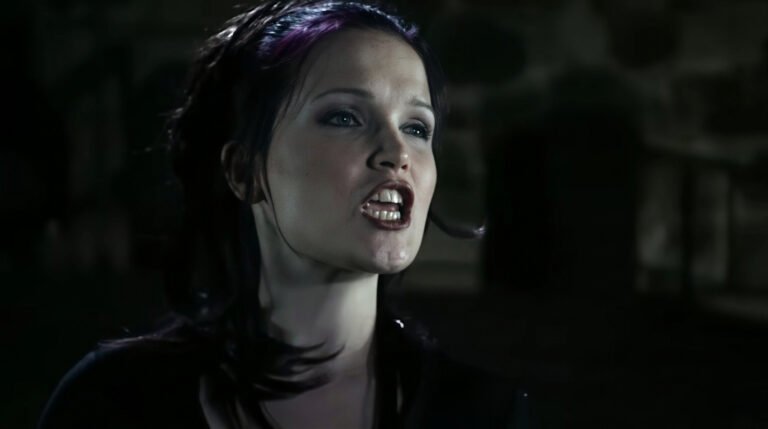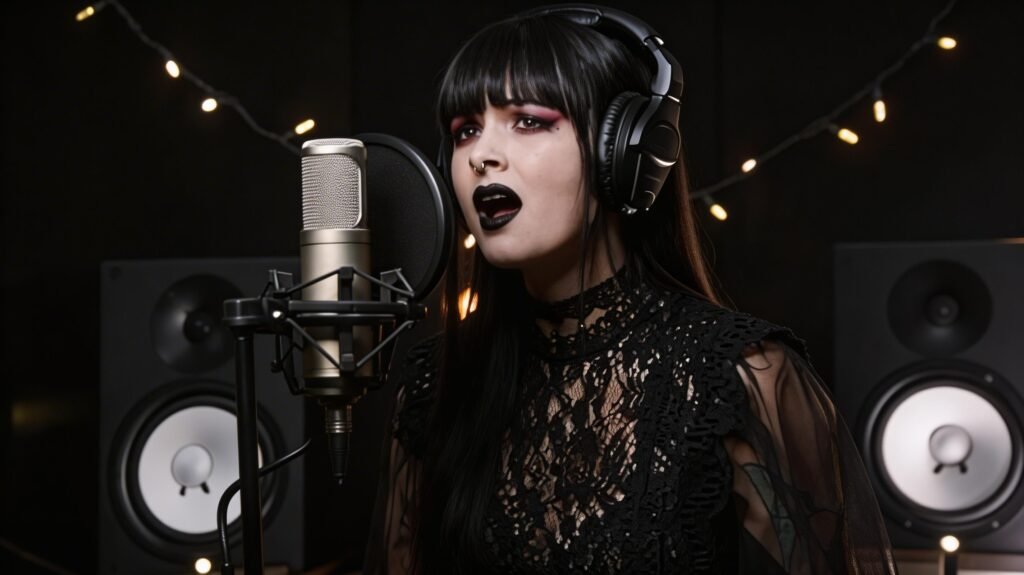
MAPHRA’s viral “Doomed” cover may have opened the door, but the real story is what happened after it. The momentum, the song choices, the mystery around her identity, and the move toward original music all point to something bigger than a one-song breakthrough.
For a new heavy-music name, that combination matters. Viral covers can disappear quickly, but MAPHRA’s rise has created a different kind of curiosity: people are not only listening to the performances, they are trying to understand the artist, the project, and where it goes next.
Who is MAPHRA? What we know so far
Who is MAPHRA? She is one of the fastest-rising names in the online heavy scene, and this is no longer just a reaction-channel story. On her official YouTube channel, Bring Me The Horizon’s “Doomed” has already climbed past 15 million views, “Circle With Me” has become a major breakout performance, and later covers like “Silence” confirmed this was not a one-song spike but the start of something much bigger. In March 2026, “Doomed” hit No. 1 on Billboard’s Hot Hard Rock Songs chart. And in May 2026, the story moved off the screen entirely — first onto a festival stage with Ice Nine Kills, and then, just nine days later, onto the Sonic Temple stage with Bring Me The Horizon themselves, performing “Doomed” alongside Oli Sykes in front of a crowd that had been waiting for exactly that moment.
Quick facts about MAPHRA: she is currently best known for viral vocal covers of Bring Me The Horizon, Spiritbox, Linkin Park, and Bad Omens. Her biggest breakout so far is “Doomed.” Her real name is not publicly confirmed, and her origin is not publicly confirmed in a way we could independently verify — the available reporting does not establish a definitive hometown or national origin. That said, Portuguese-language TikTok communities have been quick to claim her, tagging her content with phrases like “música metal brasileira” and “cantores brasileiros,” which has fuelled widespread speculation that she has Brazilian roots. What does seem clear is that this moment is not meant to end with covers alone — MAPHRA has already said that she and her team are working on original music.
What makes MAPHRA especially interesting right now is that people are not only searching for the covers. They are also searching for the person behind them — who she is, where she is from, and whether this viral moment is the start of something larger. The numbers are huge, the chart impact is real, and the curiosity around her identity is growing just as fast. You can also follow MAPHRA on her official YouTube channel and Spotify.
NoApology: From Covers to Original Fire
Before NoApology became a band, Sershen & Zaritskaya built a global following with powerful hard-rock covers. Here’s how that cover era turned into something bigger.
Read NoApology articleThe cover that changed everything
The obvious place to start is “Doomed.” It is the performance that turned MAPHRA from “someone people are suddenly seeing in their feed” into an actual breakout name. Bring Me The Horizon’s original already carries huge emotional lift, bruised grandeur, and the kind of widescreen melancholy that made it one of the band’s most beloved modern-era tracks.
What makes MAPHRA’s version stand out is that she does not try to imitate Oliver Sykes directly. His vocal on the original is frayed, wounded, and human in a very specific way — it sounds like someone trying to keep the song from collapsing under its own emotional weight. MAPHRA approaches it differently. Her take is cleaner, more controlled, and more openly cinematic, which changes the emotional texture without draining it of intensity. Instead of recreating Sykes’ vulnerability line for line, she gives the track a different kind of lift — less ragged, more soaring, but still emotionally convincing. That contrast is a big part of why the cover feels like a real reinterpretation rather than just a strong vocal exercise.
The AI question that followed her everywhere
Almost immediately after “Doomed” exploded, a second conversation opened up alongside the first: is any of this real? Because every major reaction channel on YouTube analyzed her videos almost simultaneously, a theory emerged that MAPHRA is a highly sophisticated viral marketing product — that the mystery around her identity was itself a strategy designed to feed the algorithm through debate. Vocal coaches weighed in, analysts broke down the physical mechanics of her throat movements frame by frame, and experts concluded that while post-production is present — as it is in any professional recording — the physical mechanics align with what is being heard. The AI debate did not slow her down. If anything, it kept her name circulating in spaces the covers alone might never have reached. But it also set an expectation: eventually she would have to answer the question somewhere outside a studio.
Why people are sticking around after the first viral hit
A lot of viral artists go huge once and then immediately feel smaller on the second click. MAPHRA does not have that problem, and the reason is simple: there is enough range in the voice to make the follow-up videos feel like more than minor variations on the same trick.
That comes through especially well on “Circle With Me.” Spiritbox’s original asks for control, weight, and enough fluidity to move through its mood changes without sounding glued together from separate parts. MAPHRA’s version works because she sounds comfortable inside it — not just technically capable, but genuinely at home. That distinction matters. It suggests that the appeal here is not only virality, but fit: the sense that her voice belongs in the same ecosystem as the bands she is covering.
She is already curating the right modern heavy canon
One of the smartest things about MAPHRA’s channel is the song selection. Even with a still-compact run of covers, the choices tell you exactly where she sits in the current heavy landscape. It is not random nostalgia bait — it is contemporary, algorithm-savvy, and very tuned into what online heavy audiences already obsess over.
Covers like Linkin Park’s “The Emptiness Machine” and Bad Omens’ “Impose” and “Specter” place her in direct conversation with the bands that dominate current internet-heavy culture. Linkin Park gives her mainstream emotional recognition; Bad Omens — twice over — gives her credibility inside the modern alt-metal and metalcore wave. And taking on “End of You,” the recent collaboration between Poppy, Amy Lee, and Courtney LaPlante, places her clearly inside the current female-fronted heavy conversation, which is exactly where a lot of her momentum now lives. None of these are accidental choices. They are strategically perfect for an artist building a career through high-impact cover performances rather than through a traditional industry rollout.
Silence is where her vocal potential opens op even more
If “Doomed” was the breakthrough and “Circle With Me” proved range, “Silence” is the moment MAPHRA opened up something more nuanced. The Plot In You track asks for restraint, breath control, and the ability to make quieter phrases feel heavy without oversinging them. In this cover, the voice sounds more mature — more patient, with a stronger sense of when to hold back. Instead of relying on the cinematic surge that made “Doomed” so effective, she builds pressure from stillness. It makes the case that her strongest performances may come not from the big moment, but from everything that leads up to it.
Why MAPHRA keeps spreading far beyond her own channel
A big part of MAPHRA’s rise now lives outside her own uploads. Her covers have become regular material for vocal coaches, reaction channels, and music commentators who keep breaking down what makes these performances land. A viral cover can explode once and disappear. A cover that keeps generating analysis, comparison, and repeat discussion starts building a second life across YouTube. That is one reason MAPHRA’s name keeps surfacing even for people who did not find her through the original upload. The channel may be compact, but the conversation around it already is not.
The live debut that answered one question and opened several more
In May 2026, MAPHRA stepped out from behind the screen for the first time. Ice Nine Kills brought her onstage during their May 7 set at Welcome to Rockville in Daytona Beach, Florida, where she performed the Scream 7 track “Twisting the Knife” — a song whose studio version features actress Mckenna Grace — for its live debut. It was also, by all accounts, MAPHRA’s very first live performance, throwing her straight into the deep end in front of a packed rock festival crowd.
The reception was mixed. The vocals were not as polished as the studio recordings, and in a scene still primed to question her authenticity, that gap became ammunition. But this criticism misses something important: every vocalist sounds different raw and unprocessed in front of a festival crowd for the very first time. Judging MAPHRA’s debut by the same standard as a seasoned touring artist is not just unfair — it is the kind of expectation the internet consistently applies to people it has decided to root for and against simultaneously. She walked onstage. She sang. The AI conversation, at least, was now closed — reaction channels that had spent weeks on the debate rushed to respond under titles like “MAPHRA Proves She Isn’t AI With A LIVE Performance.”
The more important chapter, however, opened nine days later. During Bring Me The Horizon’s set at Sonic Temple 2026 in Columbus, Ohio, the band brought MAPHRA onstage for a live performance of “Doomed.” When Oli Sykes introduced her to the stage, the crowd erupted. The chemistry between them was immediate — turning an already massive anthem into one of the standout live moments of the entire festival.
The difference between the two performances was never really about ten days of extra rehearsal. It was about context. Welcome to Rockville asked MAPHRA to sing someone else’s song, in someone else’s world, for an audience that did not necessarily know who she was. Sonic Temple asked her to sing her own song — the one that started everything — next to the band whose work she had built her entire identity on, in front of a crowd that had been waiting for exactly this. That is not a fair comparison. It was never going to be. And the footage confirms it: this was not a tentative guest spot or a nervous second attempt. The voice held. The stage presence was there. The emotional weight of “Doomed” landed the way it needed to. For anyone who had been following this story since the first upload, the moment carried the weight of everything the channel had been building toward. The artist who came up through covers stepped onto the stage where those covers came from — and made it feel like it always belonged to her.
The part that makes this more than a cover-artist story
What makes MAPHRA more interesting than a simple “viral vocalist of the month” is that there is already a narrative beyond the covers. In Kerrang!’s write-up of the Billboard achievement, she said she had long seen herself as a quiet person, had struggled with depression and a lack of purpose, and is now committing to music full-time. In the same statement, she confirmed that she and her team are already working on original music.
That changes how you read the whole channel. If the covers were the destination, the story would still be impressive. But if they are the runway, MAPHRA starts to look like something else entirely: an artist using the current cover ecosystem the way previous generations used demo tapes, support slots, or EP cycles. The covers become proof of concept. The real question stops being “Can she go viral again?” and becomes “What happens when she has songs of her own to point all of this attention toward?”
Where MAPHRA goes from here
The biggest risk for any artist coming up this fast through covers is obvious: people get attached to the reinterpretations but do not follow all the way into original material. That is the test MAPHRA will eventually have to pass.
The live arc of May 2026 changed what that question looks like. A stumbling first step at Welcome to Rockville — rough, criticised, and surrounded by noise — was followed nine days later by a full-circle moment at Sonic Temple that needed no explanation. That is not just good timing. That is a narrative. And an artist who can build a narrative, consciously or not, is already doing something more interesting than going viral.
She already has the hard part: attention, momentum, proven resilience under public scrutiny, and a clear lane. If the original music lands, MAPHRA has a real chance to convert this moment into something durable. If it does not, she will still remain one of the clearest examples of how fast a heavy artist can break through online by choosing the right songs and delivering them with complete conviction.
If you enjoyed this spotlight, also check out What Happened to Leo Moracchioli? The Frog Leap Story and the End of the Weekly-Cover Era and Best Slipknot Covers by Rock and Metal Artists.